
Round Rock, TX · Garage Door Service
Is Your Old Round Rock Garage Door Worth Repairing or Replacing
Round Rock homes mostly date 1978-2018, median 1996. Here's how that build era and our mild climate decide if your old door is worth repairing.
- Repairs & new doors
- Springs & openers
- Serving 4 nearby communities
The Common Mistake
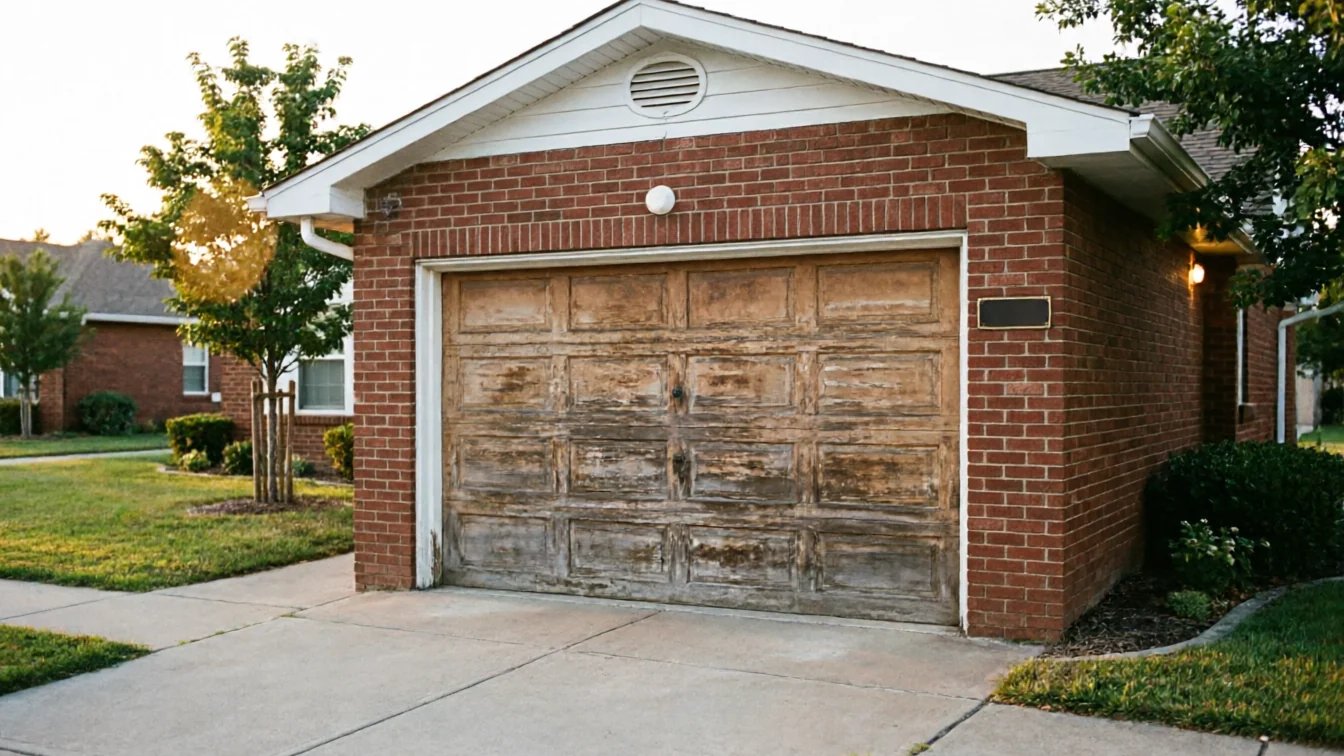
The mistake we see most in Round Rock is treating 'old' as a single category. Most houses in this service area went up between 1978 and 2018, with the median sitting at 1996, and the bulk of that stock is 1980s and 90s construction spread across the fourteen named areas we work in. That's a narrower band than people think. A door from a 1985 build and a door from a 2005 build are not the same repair conversation, even though both owners call them 'old.'
We'll get a call where someone wants a full replacement because the opener chain is loose, when the door itself - torsion spring, track, steel panel - is fine and the opener is the only failed part. The reverse happens too: a door with a warped panel or a cracked bottom section gets a new opener bolted onto a frame that's already out of square. Fixing the wrong half of the system doesn't solve the actual problem. Before you spend money either direction, the question isn't the door's age in years. It's which specific part failed, and whether the rest of the unit matches the era it was built in.
The Seasonal Bit
Round Rock sits in a mild climate band with occasional freeze mornings, not the hard freeze-thaw cycle that chews up springs and tracks in colder regions. That works in your favor if your door is original to a 1980s or 90s build - the torsion spring and hinges haven't been through decades of metal contracting and expanding across a real winter, which is usually what kills that hardware outright.
What the mild climate doesn't protect against is heat. Steel panels from that era expand under direct summer sun, and over enough years that cycle loosens panel seams and throws off track alignment even without a hard freeze ever touching the door. So the seasonal risk here isn't a frozen spring snapping on a cold morning - it's slow heat fatigue on a door that's 25 to 40 years into its life. If your door is sticking or binding only in the hottest part of the afternoon, that's the climate talking, not a sign the whole unit is done.
How Local Conditions Play In
The fourteen areas in our service radius - from Teravista three miles north to Jarrell twenty miles out, Brushy Creek, Pflugerville, Wells Branch, Robinson Ranch, and the rest - mostly share that same 1980s-to-90s construction window. That matters for parts availability. A torsion spring or roller sized for a door built in that era is still a common size; we're not hunting down obsolete hardware for a door built before 1978, because that housing stock barely exists here. The newer end of the range, closer to 2018, is a different animal - composite panels, insulated cores, different spring tension - and those doors rarely need the kind of judgment call this page is about.
So when we're deciding whether an older door in, say, Wells Branch or Serenada is worth fixing, we're almost always talking about a steel sectional door on a standard torsion system from the 80s or 90s. That's a known quantity. Parts exist, labor is predictable, and a repair holds for years rather than months - which is the whole case for fixing instead of replacing in the first place.
The Situation
Here's how we actually make the call on site. If the door is from that 1980s-to-90s window and the track, frame, and panels are square and unwarped, a broken spring or failed opener is almost always worth fixing - the hardware is standard and the rest of the door has plenty of life left. If the panels are dented past the point of alignment, or the bottom section has rotted or rusted through, replacement starts making more sense regardless of what the spring is doing.
One honest limit: we don't stock every roller and hinge size for doors built before that common range, and if your home is an outlier - older than the typical stock here - a repair can mean a longer parts wait than we'd like to quote you. In that case we'll tell you straight rather than string out a job that should be a replacement. For most houses in Round Rock and the surrounding areas, though, the door in the garage is well within the range where fixing it is the right call, not just the cheaper one.
Frequently asked questions
How do I know if my garage door is old enough to need replacing instead of fixing?
It's less about age and more about what failed. Most homes here were built between 1978 and 2018, median 1996, so a torsion spring or roller failure on a door from that range is usually a straightforward, worthwhile repair. Warped panels, rust-through, or a frame that's out of square are the signs that point toward replacement instead.
Does Round Rock's climate wear out garage door springs faster?
Not from freezing - our climate band is mild with only occasional freeze mornings, so springs don't take the freeze-thaw beating they would in a colder region. Heat is the bigger slow factor here, expanding steel panels and seams over many summers rather than snapping hardware in a single cold event.
Can you still get parts for a door from the 1980s or 90s?
Yes, in almost all cases. That era is the bulk of the housing stock across our service area, so torsion springs, rollers, and hinges sized for those doors are common stock, not special order. Doors built notably earlier than that range are where parts can take longer to source.
Related garage door services in Round Rock
More garage door guides
Book garage door service in Round Rock
Call now or request a quote - tell us what the door is doing and where you are.